
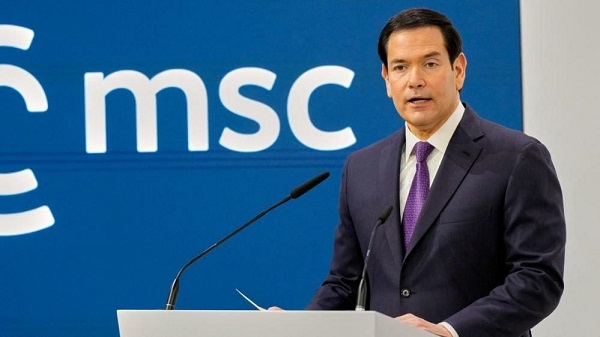
A speech by Marco Rubio at the Munich Security Conference has sparked criticism from activists and commentators across Africa, Europe and Asia, after remarks that referenced centuries of Western expansion and called for renewed alignment between the United States and Europe. In his address, Rubio said Washington and its allies were returning to a path “we have walked together before,” adding that for five centuries before the end of World War II, “the West had been expanding … to cross oceans, settle new continents, [and] build vast empires extending out across the globe.”
He said that by 1945, Western empires had entered “terminal decline,” accelerated by communist revolutions and anti-colonial uprisings that reshaped the global order. The historical framing drew swift backlash from voices in the Global South, who interpreted the remarks as nostalgic toward the colonial era.
Faridah Bemba, a Togolese human-rights activist, said the speech suggested the United States was prepared to reassert Western dominance. “Marco Rubio’s speech at the Munich Security Conference made it clear that the United States intends to restore Western domination and place its hegemony above values and multilateralism,” Bemba said. “What he is advancing is the idea that the West stands superior in civilization and must therefore dominate.”
She warned that such rhetoric risked encouraging a renewed scramble for influence over resources and political systems in developing regions.
“What we are witnessing resembles a new Berlin Conference,” she said, referring to the 1884–85 gathering that formalized the colonial partition of Africa. “If we stay silent and divided, the systems that take our wealth and limit our choices will only grow stronger.”
Criticism also emerged from European commentators.
Arnaud Bertrand, a French analyst, described the address as “one of the most revisionist and imperialist speeches” by a senior American official in recent years.
“The man literally laments the outcome of World War II because it marked the end of the era during which ‘the West had been expanding’,” Bertrand wrote on social media. He added that the speech appeared to call for the restoration of “vast empires extending across the globe” and portrayed the post-colonial order as a mistake.
Bertrand also criticized the reaction in Munich, noting that part of the audience reportedly gave Rubio a standing ovation.
“It just goes to show the complete absence of reflection in Europe,” he wrote, arguing that the speech appeared to appeal to “latent nostalgia for Western imperial dominance.”
China’s response
Chinese officials also weighed in, using the controversy to reinforce their critique of Western leadership.
Wang Yi, China’s foreign minister, said the global system was struggling because of countries that “magnify differences, put themselves above others and revive Cold War mentality.”
“To safeguard international collaboration, it is important to seek common ground while shelving differences and pursue win-win cooperation,” Wang said in remarks circulated by Chinese state media.
Debate over global order
The reactions reflect deeper tensions over the future of the international system, as countries in Africa, Asia and Latin America seek more diversified partnerships amid intensifying rivalry between major powers.
Across Africa, governments are increasingly balancing relations among the United States, China, the European Union, Gulf states and emerging partners such as India and Turkey, seeking investment without exclusive alignments.
Analysts say Rubio’s speech highlights how Western rhetoric is now interpreted through the lens of colonial history and economic competition.
For many policymakers and commentators in the Global South, the episode underscores a growing concern that the emerging world order may be shaped less by multilateral cooperation and more by renewed competition among major powers for influence, resources and strategic advantage.