A protester has appeared in court wearing a burqa to deny a charge of wearing the Islamic religious garment to conceal his identity during a Hampshire protest.
Read More »

A protester has appeared in court wearing a burqa to deny a charge of wearing the Islamic religious garment to conceal his identity during a Hampshire protest.
Read More »
Zimbabwean writer Simbarashe Kundizeza has denied using artificial intelligence (AI) to write his short story, which won this year’s Caine Prize for African Writing.
Read More »
A civil servant is accused of earning almost £350,000 by juggling five full-time public sector roles – using sick notes and working from home to cope with the workload.
Read More »
Three sisters of Nigerian descent whose bodies were recovered from the sea off Brighton took their own lives, a coroner has ruled.
Read More »
It’s been a recurring scenario that never changes: a dramatic abduction, an agonizing week of silence, and then, the inevitable headline of a “successful rescue” triggering national euphoria.
Read More »
Following the death of a 28-year-old lab technician in Russia last week reportedly after an accident at an anti-plague research laboratory, dozens have reportedly been quarantined.
Read More »
The government has begun steps to transform the Ghana Space Science and Technology Institute (GSSTI) into a fully-fledged Space Agency following Cabinet approval for the establishment of the agency.
Read More »
Germany’s former intelligence chief August Hanning has been arrested on suspicion of espionage, attempted treason, and passing state secrets to a foreign intelligence service.
Read More »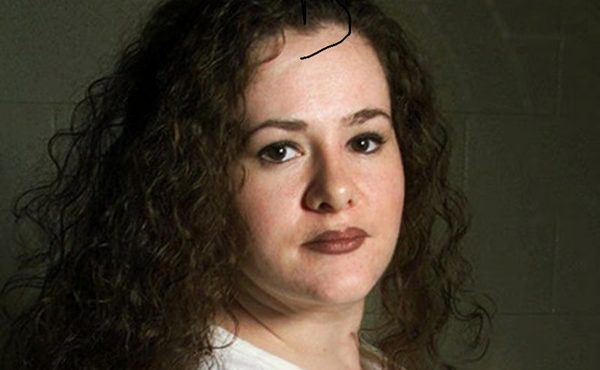
The failed attempted execution that took place in Nashville, Tennessee during the week is an indictment of Americas death penalty culture and the dearth of morality in a supposed society founded on Christian principles.
Read more: DEATH’S DOOR: Two Lethal Injections Could Not Execute Tennessee Woman On DeathrowChrista Pike is supposed to be the first woman in the state to be executed in 200 years. However, following her injection of a lethal drug, Pike was transported to an off-site medical facility. Her Attorney said Pike was being treated at a hospital, but they did not know her condition.
Fifty-year-old Pike was convicted of murdering a classmate, Colleen Slemmer, 19, in 1995 and sentenced to death. Pike was 18 at the time of the murder.
In a news conference Wednesday night, journalists who witnessed the botched execution, described snoring and complaints from Pike about pain, as well as her kicking her feet so often that she knocked off the sheets laid on her. At times, the curtain was closed and journalists could only hear sounds.

Slemmer’s mother, May Martinez, described the failed execution attempt.
“It was a mess.”
Gov. Bill Lee, a Republican, said in a statement that he was ordering “a comprehensive, third-party review to determine exactly what occurred.” He then suspended the last remaining execution for this year in Tennessee.
A spokesperson for the Department of Correction said the state “followed every step of the State’s lawful, established execution protocol approved by the Attorney General’s Office” and that “the lethal injection chemical in the protocol has consistently been effective.”

The resumption of fighting in the north of Ethiopia is raising fears of a new humanitarian crisis in an already troubled region.
Read more: ETHIOPIA: Fighting Resumes Between TPLF And Government ForcesHeavy clashes have resumed between the Tigray People’s Liberation Front (TPLF) and the federal government after the TPLF seized airports and launched attacks into the neighbouring Ethiopian states of Afar and Amhara, saying they were engaged in a “defensive war” against the government of Prime Minister Abiy Ahmed.
A humanitarian source estimated that at least 150,000 people have been displaced in Afar but said it was impossible to give precise numbers.
International NGO Human Rights Watch (HRW) expressed concerns over the situation.
“With an uptake in fighting in Ethiopia, we see the risk to civilians spreading at a time when diplomatic attention and scrutiny of the situation have reduced, given the broader dynamics and catastrophes throughout the region as well”, said Laetitia Bader, deputy director of the Africa division at HRW.
“The region is already facing devastating human rights and humanitarian crises”, she added. “In neighbouring Sudan, we are talking about the biggest humanitarian crisis in the world.”
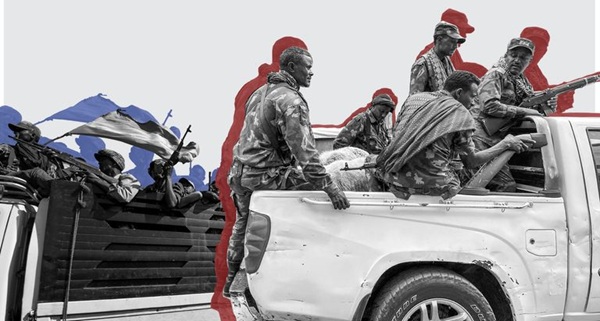
Meanwhile, Ethiopia’s army commander on Sunday accused Eritrea and Sudan of backing armed groups fighting its troops in the north of the country.
Speaking on the army’s YouTube channel, army chief Field Marshal Birhanu Jula said: “We are fighting forces that are organised and allied to serve the interests of external forces.”
“Neither Shaebia (Eritrea) nor the TPLF can achieve anything alone, even if they are allied, unless they are backed, supported and supplied by Sudan, Egypt and other external powers”, he added.
The TPLF has allied with seven-armed groups around the country, and appears to repeating a strategy from the last war of pushing south through Amhara towards Addis Ababa,
Its offensive in Afar is aimed at cutting supplies from Djibouti, which provides almost all of Ethiopia’s international trade cargo, including fuel.
The headquarters of Tigrai TV, seen as the key outlet for the rebel authorities in the Tigrayan capital, Mekelle, was hit by a drone on Sunday.
Communications have been limited since Friday when telecoms providers reported major disruption to phone and internet services in Tigray, making reporting on the conflict difficult.
Many in Tigray fear a repeat of a blockade imposed by the federal government during the 2020-2022 conflict when electricity, banking, and almost all aid were cut off.
United Nations chief Antonio Guterres raised the alarm on Friday, his spokesman saying Guterres was “particularly troubled by reports of the use of drones as well as incidents of harm to civilians”.